
AML Remediation & Programme Assurance
Independent oversight, governance and quality assurance for AML remediation programmes, customer file reviews and large-scale lookbacks.
Helping firms deliver successful remediation programmes that Boards, regulators and senior management can trust.
Why remediation programmes fail.
Remediation programmes rarely fail because the work is impossible. They fail because governance, oversight and quality assurance fall behind the pace of delivery, and because the management information presented to Boards and supervisors does not honestly reflect the state of the programme.
By the time a regulator asks the difficult questions, the issues have usually been visible for some time.
- ·Unclear governance and decision-making accountability
- ·Inadequate management information and Board reporting
- ·Insufficient quality assurance and second-line oversight
- ·Population scoping that is not genuinely risk-based
- ·Operational delivery running ahead of governance
- ·Insufficient evidence to demonstrate remediation outcomes to supervisors
“Almost every programme I have been asked to recover failed in the same place. Not in the file work, but in the governance around it. By the time the MI stops being credible, the regulator is already asking why.”
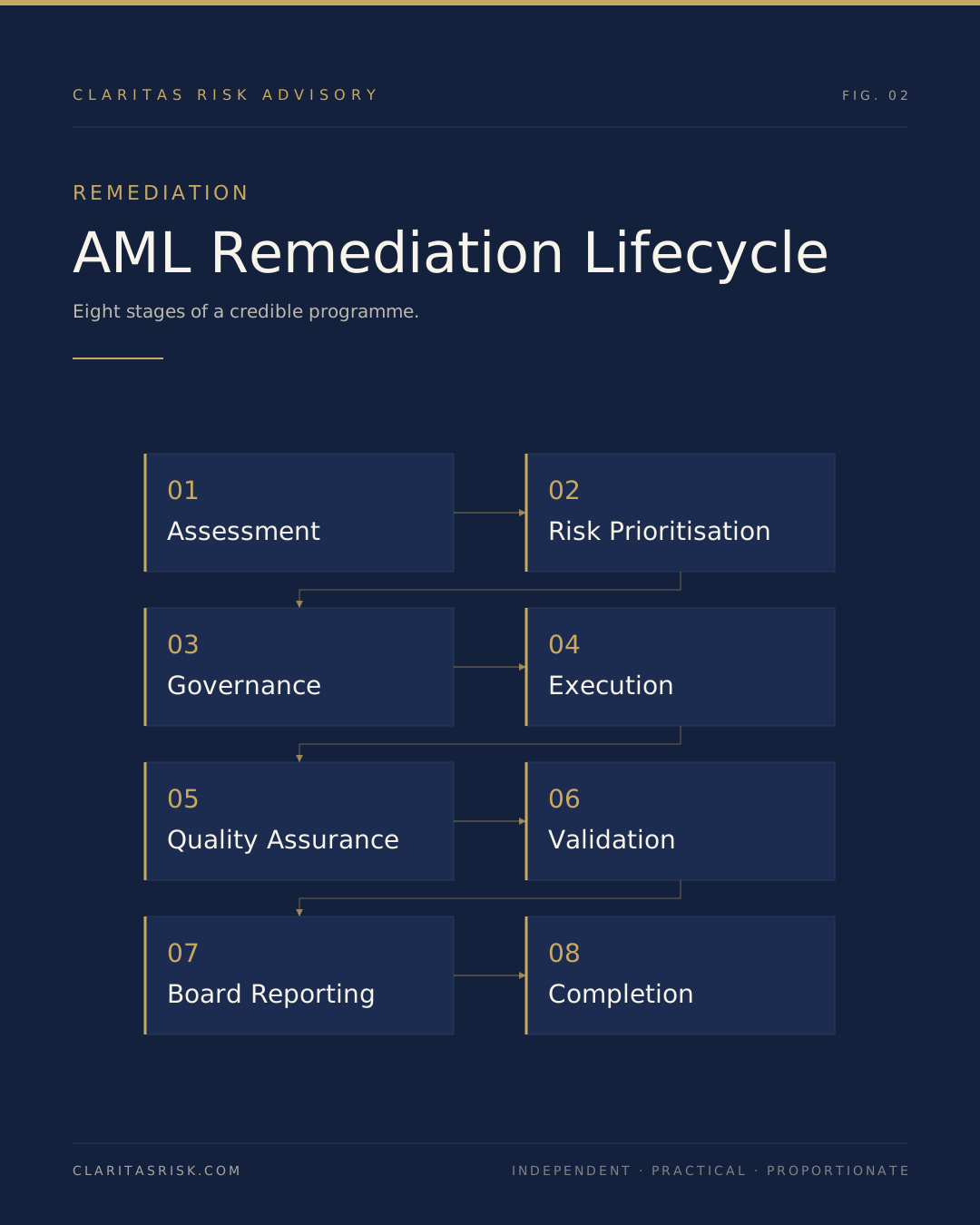
Eight stages of a credible programme.
A remediation programme is credible only when each stage is governed, evidenced and reported on its own terms. Claritas provides independent assurance across all eight.
Three ways we work, one independent standard.
Most firms do not need a large delivery team. They need senior, independent perspective in the right places. We engage at the level that fits the programme, from light-touch oversight to hands-on remediation delivery.
| Dimension | Independent Oversight | Quality Assurance | Hands-on Delivery |
|---|---|---|---|
| Best for | Programmes that need senior challenge at governance and Board level | Programmes where the integrity of file outcomes must be evidenced | Programmes that need experienced practitioner input alongside the team |
| What we do | Steering committee challenge, governance papers, MI review, supervisory narrative | QA framework design, sample calibration, defect classification, second-line testing | Senior secondment on scoping, methodology, complex files and remediation execution |
| What we do not do | Day-to-day file work or operational management | Replace your first-line QA or Internal Audit function | Provide volume resource or junior delivery teams |
| Typical engagement | Two to four days a month, often for the life of the programme | Initial framework build, then periodic calibration and review cycles | Senior input on a defined workstream or recovery phase |
Independent assurance across six dimensions.
- 01
Governance & Oversight
Independent challenge to programme governance, steering committees, escalation routes and decision-making, so the right issues reach the right people on time.
- 02
Quality Assurance
A proportionate QA framework, sample sizing, calibration, defect classification and remediation, that gives Boards confidence in the integrity of customer file outcomes.
- 03
Programme Oversight
Independent assurance over delivery: scope, sequencing, dependency management and progress reporting against a credible plan.
- 04
Management Information
MI that distinguishes activity from outcomes, clearance rates, defect trends, risk-based prioritisation and the population still outstanding.
- 05
Board Reporting
Concise, honest, decision-useful reporting that gives the Board a clear picture of progress, risk and what remains to be done.
- 06
Steering Committee Support
Independent perspective in the room, surfacing emerging risks, challenging assumptions and helping the committee govern rather than observe.
Customer migration programme, UK regulated financial institution.
A major customer portfolio was being migrated under a fixed timetable. Governance, scope and QA arrangements had not kept pace with planning, and the Board needed independent assurance that the migration would withstand supervisory scrutiny.
Independent oversight across an eight-month programme, governance papers, steering committee challenge, risk-based scoping of the in-scope population, and a calibrated QA framework with clear defect classification.
Approximately 30% of the initial population was removed from scope through risk-based assessment before migration commenced. Board reporting improved materially and the programme completed within plan.
- 01Risk-based scoping changed the size of the problem before delivery began.
- 02Honest MI gave the Board and supervisors a programme they could trust.
- 03Independent challenge to governance prevented late, costly findings.
Considered answers.
Earlier is better. Independent oversight is most valuable when governance, scope and the quality assurance framework are being established, not after delivery has stalled or supervisors have asked questions.
Internal Audit typically tests after the fact. Independent programme assurance works alongside the programme in real time, helping shape governance, MI and QA so that issues are addressed before they crystallise into findings.
No. We provide independent oversight, governance and quality assurance over delivery led by your team or third parties. Our value is independent perspective, not additional headcount.
Yes. We are often engaged where a programme has lost momentum, where MI no longer tells a credible story, or where the Board has lost confidence in the plan. The first step is usually a short diagnostic.
We help structure the evidence pack, governance narrative and MI that supervisors expect to see, and rehearse the conversation before it happens.
A remediation programme the Board, the regulator and senior management can trust.
If you are running, scoping or recovering an AML remediation programme, an initial confidential conversation is the simplest place to start.